
Attract More Event Enquiries with Event Management Google Ads agency in Bangalore
Looking for the Best Event Management Google Ads Agency in Bangalore to promote your event planning services and attract potential clients? DigitalClouds helps event planners, wedding organizers, and corporate event companies reach relevant audiences through targeted Google Ads campaigns, compelling advertisements, and strategic location targeting to increase visibility and encourage event enquiries.
- Why It's Matters
Why Are Event Management Google Ads Important for Event Businesses?
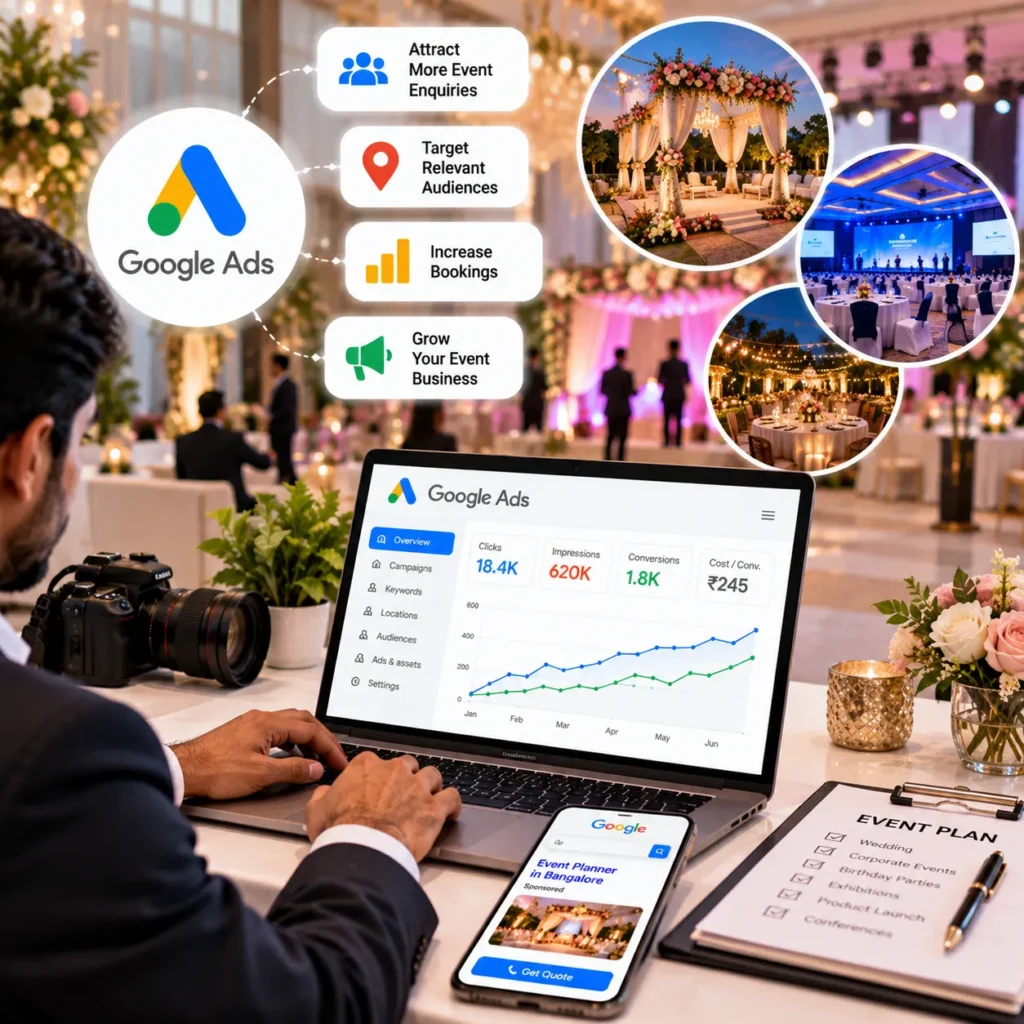
People searching for event services often need wedding planners, corporate event organizers, birthday party planners, or exhibition management companies. Event Management Google Ads help businesses reach relevant audiences, promote specific services, improve online visibility, and attract potential clients through targeted keywords, location-based advertising, and performance tracking, supporting more effective budget management and relevant event enquiries.
Promote your services when people search for wedding planning, corporate event management, birthday celebrations, conferences, exhibitions, or other events you organize. Relevant keyword targeting helps connect your advertisements with searches aligned with your service offerings.
Create dedicated campaigns for weddings, corporate gatherings, private parties, product launches, exhibitions, and other event categories. Separate campaign structures help align advertising messages, landing pages, and budgets with the requirements of different event audiences.
Direct interested visitors to pages featuring your services, event packages, portfolio, and enquiry options. Properly configured conversion tracking helps identify which campaigns generate measurable contact requests, consultation bookings, or other relevant actions.
Reach audiences searching for event services in Bangalore and other locations your business serves. Geographic targeting can help concentrate advertising around suitable service areas, venues, and business markets rather than spending indiscriminately across unrelated locations.
Support advertising campaigns around wedding seasons, festive celebrations, annual corporate gatherings, exhibitions, and planned promotional events. Campaign schedules and budgets can be adjusted according to service availability, booking timelines, and upcoming business priorities.
Use relevant advertisements and landing pages to communicate your event categories, planning capabilities, portfolio, and available services. Clear messaging helps prospective clients understand what your company offers before deciding whether to explore your work or contact your team.
Monitor available metrics such as impressions, clicks, advertising costs, conversion rates, and cost per tracked enquiry. These measurements help you evaluate campaign activity and identify opportunities to improve targeting, advertising messages, and landing page performance
Allocate advertising budgets according to your service priorities, target markets, and upcoming booking requirements. Regular campaign reviews help identify where spending may be adjusted, allowing your event business to refine its advertising approach as performance data becomes available.
- Services
What Event Management Google Ads Services Do We Offer for Your Business Growth?
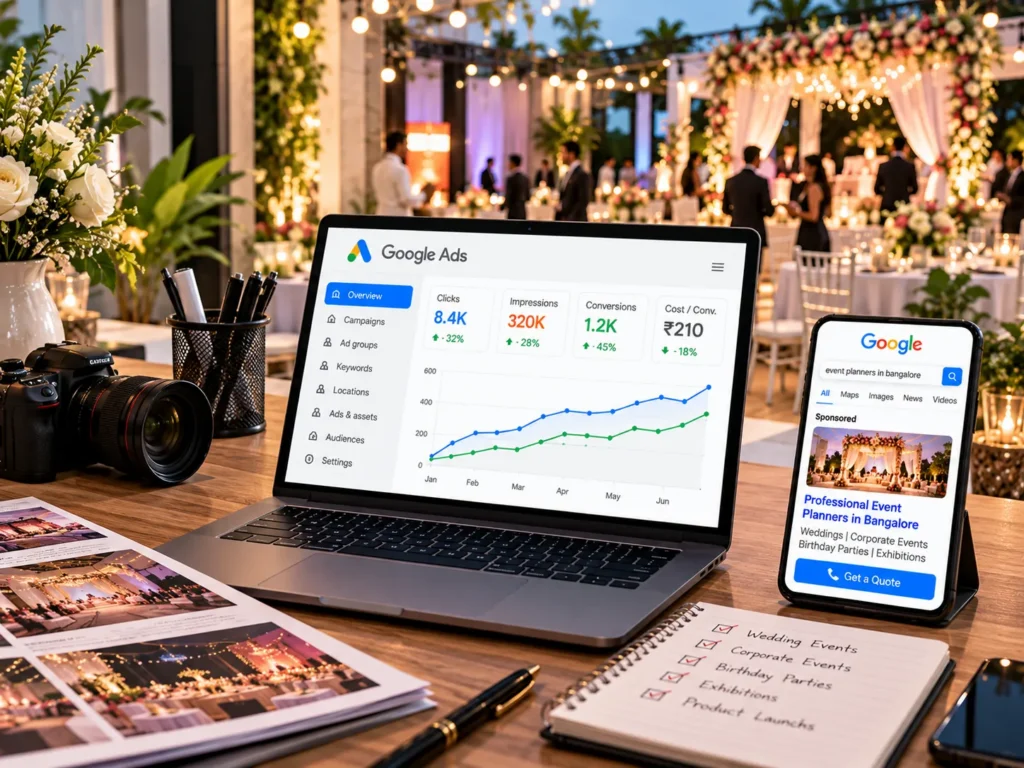
DigitalClouds provides Event Management Google Ads services tailored to your event categories, target locations, booking objectives, and advertising budget. We create targeted Google Ads campaigns that connect your event planning services with relevant searches, improve advertising efficiency, and help generate qualified enquiries through continuous campaign monitoring and optimization.
Event Management Google Ads Strategy
We develop Google Ads strategies based on your event services, target audience, service locations, and budget. Our campaign planning establishes clear advertising objectives, suitable campaign types, and targeting priorities to support measurable business growth.
Event Management Keyword Research
We identify relevant Google Ads keywords for wedding planning, corporate events, exhibitions, conferences, and party management. Search intent analysis and negative keyword selection help focus your advertising budget on searches relevant to your event services.
Event Management Search Ads
We create Google Search Ads that highlight your event planning services, packages, and business strengths. Relevant headlines, compelling descriptions, and appropriate keyword targeting help connect your business with people actively searching for event management solutions.
Location-Based Google Ads Campaigns
We configure Google Ads location targeting for Bangalore and other areas your business serves. Campaigns can be organized by event category and service location to align advertising messages with local demand and your operational coverage.
Event Management Landing Page Optimization
We optimize landing pages used in your Google Ads campaigns to align with search intent and advertisement messaging. Clear service details, relevant portfolio examples, prominent calls to action, and accessible enquiry forms help visitors take the next step.
Event Management Ad Copywriting
We write Google Ads headlines, descriptions, and relevant ad assets that communicate your event planning expertise and service offerings. Messaging is tailored to campaign keywords, event categories, and customer needs while keeping promotional claims accurate.
Google Ads Conversion Tracking
We configure and review conversion tracking for event enquiries, consultation requests, phone calls, and relevant form submissions. Accurate measurement helps assess which Google Ads campaigns and keywords contribute to meaningful enquiries and business opportunities.
Google Ads Audience Remarketing
We assess suitable Google Ads audience strategies, including remarketing where available and permitted. Based on campaign eligibility, consent requirements, and audience data, we identify opportunities to reconnect with previous website visitors interested in your event services.
Event Management Google Ads Optimization
We regularly review keyword performance, search terms, click-through rates, conversion data, and advertising costs. These insights guide adjustments to bids, targeting, ad messaging, and budgets to improve campaign efficiency and support your enquiry generation goals.
- WHY DIGITALCLOUDS
Why Choose DigitalClouds for Event Management Google Ads?
DigitalClouds combines paid search planning, event-related keyword research, geographic targeting, advertisement development, and performance monitoring to support event businesses. Our approach considers your event categories, booking cycles, target locations, and marketing objectives when developing campaigns. We focus on connecting relevant searches with suitable services, measuring meaningful website actions, and refining campaign decisions using available performance data.
Campaigns Tailored to Your Event Categories
We plan advertising around the services your business actually provides, from wedding planning and corporate gatherings to exhibitions, conferences, and private celebrations. This helps ensure that campaign priorities reflect your service portfolio and booking requirements.
Search Intent and Keyword Relevance
We research event-related search terms and organize keywords according to service type, location, and user intent. Careful keyword selection and negative keyword planning help reduce exposure to unrelated searches and improve the relevance of your advertising traffic.
Location-Focused Advertising Strategy
We configure geographic targeting around Bangalore and other relevant service areas based on your operational coverage. Campaigns can be organized by location or event category to help direct advertising budgets toward markets that align with your business objectives.
Conversion-Focused Campaign Planning
We review how advertisements connect with service pages, event portfolios, enquiry forms, and contact options. This helps identify opportunities to make the next step clearer for potential clients and improve the measurement of relevant website actions.
Conversion Measurement and Performance Analysis
We evaluate available advertising data, including spending, impressions, clicks, conversion rates, and cost per tracked enquiry. Reporting helps explain campaign performance and supports informed decisions about budget allocation, keyword adjustments, and advertising improvements.
Ongoing Optimization and Testing
We assess campaign performance regularly and identify suitable adjustments to keywords, advertisements, targeting, bidding, and landing page recommendations. Changes are guided by available data, campaign objectives, booking priorities, and the evolving requirements of your event business.
- Event Management Google Ads Process
How Does Our Event Management Google Ads Process Work?
Our Event Management Google Ads process focuses on understanding your services, researching relevant searches, structuring campaigns, creating suitable advertisements, and measuring campaign performance. We begin by reviewing your event categories, service locations, booking objectives, website, and advertising budget. Each stage addresses a specific part of the campaign lifecycle, helping your business make informed advertising decisions and identify opportunities to improve the relevance and effectiveness of paid search campaigns.
Step 01 of 08 · Campaign Analysis
Event Management Google Ads Audit and Competitor Analysis
Assess your current advertising position and identify opportunities to improve event campaign performance.
Before launching new campaigns or refining existing ones, we review your Google Ads account where available, event service pages, website functionality, target locations, and marketing objectives. We also examine relevant competing businesses and publicly observable advertising approaches to understand market positioning. This assessment helps identify campaign gaps, keyword opportunities, tracking issues, and areas where advertising relevance may be improved.
Our campaign analysis activities include:
- Google Ads Account Review: Examine available campaign settings, ad groups, keywords, budgets, bidding strategies, targeting options, and historical performance to identify issues that may affect spending, advertising relevance, or the measurement of event enquiries.
- Event Service Portfolio Assessment: Review your wedding planning, corporate event, exhibition, party management, conference, and other services to understand which categories deserve dedicated campaigns and how advertising priorities should reflect your available capabilities.
- Competitor Advertising Research: Examine relevant competing event businesses and publicly visible search advertisements to understand their service positioning, messaging, and market focus without assuming access to private campaign settings or confidential performance data.
- Website and Landing Page Evaluation: Assess whether your website communicates event categories, planning packages, portfolio examples, locations, and enquiry options clearly enough to support visitors arriving from paid search advertisements.
- Campaign Structure Assessment: Review whether campaigns separate important service categories, locations, or objectives appropriately, making it easier to manage budgets, tailor advertisement messages, and evaluate the performance of different event services.
- Keyword and Search Term Review: Examine available keyword and search-term data to identify relevant searches, unrelated queries, missing service opportunities, and possible negative keywords that may improve the relevance of your advertising traffic.
- Conversion Tracking Assessment: Review configured conversion actions, website form tracking, call measurement where available, and relevant analytics settings to determine whether the account records the actions your event business wants to measure.
- Campaign Improvement Roadmap: Develop a prioritized plan covering campaign structure, keyword research, geographic targeting, advertisement development, landing page recommendations, and measurement requirements according to your business goals and initial findings.
Step 02 of 08 · Keyword Research
Event Management Keyword Research Based on Search Intent
Identify relevant searches that connect your event services with people looking for suitable planning and coordination support.
Keyword research helps us understand how users search for wedding planners, corporate event organizers, party planning companies, exhibition managers, and related services. We assess the relationship between search intent, service categories, and geographic modifiers before organizing suitable terms into campaigns. We also identify irrelevant search patterns and develop negative keyword recommendations to reduce unnecessary spending.
Our event management keyword research activities include:
- Event Service Keyword Research: Identify relevant searches for wedding planning, corporate events, private parties, conferences, exhibitions, product launches, and other event services your business genuinely offers to potential clients.
- Location-Based Keyword Research: Research relevant event service searches involving Bangalore, suitable neighborhoods, and other genuine service locations to help align advertising with the geographic markets your business can realistically serve.
- Event-Type Keyword Grouping: Separate keywords according to event categories and service requirements, helping wedding planning searches, corporate event searches, and private celebration searches receive advertisements that match their specific intent.
- Search Intent Analysis: Distinguish between people researching event ideas, looking for venues, searching for event planners, or seeking specific management services so campaigns prioritize queries appropriate to your actual offerings.
- Competitor Keyword Research: Review relevant publicly available search opportunities and keyword research data to discover possible gaps in your advertising coverage while evaluating whether those terms match your services and target audiences.
- Negative Keyword Planning: Identify unrelated searches, unsuitable event categories, job-related queries, and other irrelevant patterns where appropriate, applying negative keywords carefully to reduce wasted spending without excluding valuable event service searches.
- Keyword-to-Page Mapping: Connect selected keywords with suitable event service pages or landing pages so advertisements direct users to information that reflects their original search and the service being promoted.
- Keyword Prioritization and Review: Prioritize terms using relevance, available search demand estimates, competition indicators, and business objectives, then refine the keyword list using actual campaign data after advertisements begin serving.
Step 03 of 08 · Campaign Setup
Event Management Google Ads Campaign Structure and Configuration
Build an organized campaign framework around your event services, geographic coverage, advertising objectives, and budget.
Following keyword research, we configure campaigns according to your business priorities and the types of events you manage. Campaigns may be organized around weddings, corporate gatherings, exhibitions, private parties, or specific service locations where separate structures improve control and reporting. We also review suitable campaign objectives, budgets, geographic settings, bidding strategies, and conversion goals before launch.
Our campaign setup activities include:
- Campaign Objective Selection: Define whether the primary objective is relevant enquiry generation, consultation requests, tracked phone calls, or another measurable website action, then choose a suitable campaign setup based on your goals and account capabilities.
- Event Category Segmentation: Separate major service categories when doing so improves advertisement relevance, budget management, and performance reporting, ensuring that campaigns reflect meaningful differences between corporate events, weddings, exhibitions, and private celebrations.
- Geographic Targeting Configuration: Configure location targeting around Bangalore and other relevant service areas, reviewing available location settings so advertisements focus on markets where your event business can provide the advertised services.
- Budget Allocation Planning: Distribute advertising budgets according to service priorities, expected search demand, competition, and booking requirements, while accounting for the fact that actual traffic and enquiry volumes cannot be guaranteed.
- Bidding Strategy Configuration: Select an appropriate bidding approach based on campaign objectives, conversion data, budget constraints, and account maturity, reviewing performance before making substantial changes to bidding or budget settings.
- Network and Language Settings: Review available network and language settings to ensure campaign delivery aligns with your intended audience, service locations, advertising goals, and the search environments relevant to your event management business.
- Ad Group Organization: Group related keywords into focused ad groups so advertisements can address specific event services and direct visitors to appropriate landing pages rather than presenting broad messaging for unrelated offerings.
- Campaign Settings Verification: Check budgets, campaign schedules, destination URLs, geographic coverage, conversion goals, and other important settings before launch to reduce avoidable configuration mistakes and prepare campaigns for consistent monitoring.
Step 04 of 08 · Advertisement Development
Event Management Google Ads Copywriting and Ad Asset Creation
Develop compelling, relevant advertisements that communicate your event services clearly and encourage suitable visitors to explore your offerings.
Event advertisements should reflect the service being promoted, whether it involves corporate event coordination, wedding planning, exhibition management, or private celebrations. We create headlines and descriptions that highlight verified capabilities, relevant locations, and appropriate service benefits. Where supported, we also configure eligible ad assets and test messaging variations to understand which approaches better support campaign objectives.
Our advertisement development activities include:
- Event-Focused Headlines: Write concise headlines that communicate the event category, relevant service, or target location, helping users quickly understand whether your company offers the planning or coordination support they are searching for.
- Service-Oriented Ad Descriptions: Develop descriptions that explain your planning capabilities, coordination services, event formats, and other verified offerings without making unsupported claims about guaranteed bookings, event outcomes, or promotional benefits.
- Location-Relevant Messaging: Incorporate appropriate Bangalore or other service-area references where relevant, ensuring that geographic messaging accurately reflects your operational coverage and matches the destination page associated with each advertisement.
- Service Benefit Communication: Highlight relevant capabilities such as event coordination, vendor management, corporate event planning, exhibition support, or wedding planning when these services are genuinely available and useful to the intended audience.
- Call-to-Action Planning: Select suitable calls to action that encourage visitors to explore event packages, request a quotation, discuss requirements, or contact your team without creating misleading expectations about pricing or service availability.
- Ad Asset Configuration: Review eligible assets such as sitelinks, call assets, callouts, and structured snippets where supported, helping advertisements communicate additional service details and direct users to relevant sections of your website.
- Advertisement Variation Testing: Develop suitable advertisement variations to compare messaging themes, service descriptions, and calls to action, evaluating available performance data before deciding which wording deserves further testing or refinement.
- Advertising Accuracy and Policy Review: Check advertisement wording, destination pages, promotional claims, and applicable platform requirements before launch, ensuring that published messages accurately describe your event services and comply with relevant advertising policies.
Step 05 of 08 · Landing Page Optimization
Event Service Landing Page and Enquiry Experience Optimization
Help visitors find relevant event information and move smoothly from an advertisement to an enquiry.
A landing page should continue the message introduced by the advertisement and give visitors a clear understanding of the event services being promoted. We assess service descriptions, portfolio presentation, package information, enquiry forms, mobile usability, and calls to action. Where website development is outside the agreed advertising scope, we provide practical recommendations for implementation by your website team.
Our landing page optimization activities include:
- Advertisement-to-Page Relevance: Check that each advertisement directs visitors to a page matching the event category, service location, and promotional message, reducing confusion caused by sending unrelated searches to a generic homepage.
- Event Service Information Review: Assess whether landing pages explain the relevant planning services, event formats, available packages, coordination capabilities, and other verified details visitors may need before deciding to contact your company.
- Portfolio and Event Gallery Assessment: Review the presentation of suitable event photographs, project examples, and portfolio categories, helping visitors understand your company’s experience while ensuring that published images are authorized for use.
- Enquiry Form Assessment: Evaluate form length, field relevance, validation, confirmation messages, and usability to identify unnecessary obstacles while collecting the information your team needs to understand the client’s event requirements.
- Call-to-Action Placement: Review whether enquiry buttons, phone numbers, quotation requests, and consultation options are easy to locate, helping interested visitors understand how to discuss their event plans with your team.
- Mobile Landing Page Review: Check readability, navigation, image presentation, loading behavior, and form interactions on smartphones, ensuring that visitors can explore event services and submit enquiries without avoidable usability problems.
- Page Speed Recommendations: Review available performance indicators and identify potential issues such as oversized event images, unnecessary scripts, or slow page elements that may affect how quickly visitors can access service information.
- Landing Page Performance Evaluation: Compare available engagement and conversion data to identify pages that may need clearer messaging, stronger service relevance, or technical improvements, prioritizing changes according to campaign objectives and evidence.
Step 06 of 08 · Conversion Tracking
Event Management Google Ads Conversion Tracking and Enquiry Measurement
Measure meaningful website actions to understand how paid advertising contributes to your event business objectives.
Conversion tracking helps connect advertising activity with actions such as completed enquiry forms, quotation requests, consultation bookings, and phone calls where measurement is available. We review relevant tracking configurations, test events where possible, and help distinguish recorded conversions from enquiries that your team has reviewed and qualified. Reliable measurement provides a stronger basis for evaluating campaign effectiveness and deciding where optimization is needed.
Our conversion tracking activities include:
- Conversion Goal Definition: Identify the actions that matter to your event business, distinguishing primary enquiry submissions from supporting interactions so campaign reporting reflects meaningful marketing objectives rather than treating every website action equally.
- Enquiry Form Tracking: Configure or review tracking for successful enquiry submissions where supported, ensuring that measurements reflect completed forms instead of simply recording button clicks or incomplete form interactions.
- Quotation Request Measurement: Where your website supports quotation requests, review suitable tracking so the business can evaluate how advertising contributes to requests for event packages, corporate functions, weddings, exhibitions, or other relevant services.
- Phone Call Measurement: Review available call tracking options for calls originating from advertisements or website visits, subject to account eligibility, technical configuration, consent requirements, and the measurement tools available to your business.
- Google Tag and Analytics Review: Assess relevant tag and analytics configurations to identify whether required events are recorded consistently and whether the measurement setup reflects the conversion goals selected for your campaigns.
- Conversion Action Testing: Test configured conversion events where access and technical conditions permit, checking whether completed actions are recorded as expected and identifying missing, duplicated, or incorrectly triggered tracking events.
- Primary and Secondary Conversion Configuration: Help distinguish the actions used for campaign optimization from supporting measurements, reducing the risk of directing campaign decisions toward low-value interactions instead of the enquiries your business prioritizes.
- Conversion Reporting and Quality Review: Review available conversion reports and suitable feedback from your team to understand whether recorded actions correspond with relevant event enquiries, while recognizing that a tracked conversion does not automatically represent a confirmed booking.
Step 07 of 08 · Campaign Optimization
Event Management Google Ads Performance Optimization and Budget Management
Refine advertising decisions through ongoing review of search behavior, campaign costs, and measured enquiry activity.
After campaigns begin serving, we evaluate performance to identify opportunities to improve keyword relevance, advertisement messaging, targeting, bidding, and budget allocation. Optimization decisions account for campaign objectives, conversion volume, booking requirements, and available data. Rather than applying identical changes to every campaign, we prioritize adjustments based on observed performance and the distinct requirements of your event services.
Our campaign optimization activities include:
- Search Term Optimization: Review available search-term reports to identify unrelated queries, discover relevant event service searches, and recommend appropriate negative keywords that may reduce unnecessary expenditure without blocking valuable advertising opportunities.
- Keyword Performance Review: Compare keyword relevance, spending, click activity, and recorded conversions to identify terms that may require adjustments, restructuring, additional research, or reduced investment based on the campaign’s intended objectives.
- Budget and Bid Adjustments: Assess campaign spending against performance and booking priorities, making controlled adjustments where justified while considering available conversion data, competitive conditions, and the possibility of limiting useful advertising traffic.
- Advertisement Performance Testing: Review available metrics across advertisement variations and eligible assets, identifying messaging that appears more relevant to users while considering traffic volume, conversion quality, and other factors affecting reliable interpretation.
- Geographic Performance Review: Examine available performance data across targeted locations to identify markets that may deserve further investment, closer monitoring, or reduced exposure according to service coverage and the event categories being promoted.
- Device and Schedule Analysis: Review device-related and time-related campaign data where useful, looking for meaningful patterns in engagement and enquiries before recommending adjustments to schedules, device settings, or other available campaign controls.
- Landing Page and Conversion Analysis: Compare advertising activity with landing page behavior and recorded enquiry actions to identify potential gaps between the advertisement’s message, the service information presented, and the next steps available to visitors.
- Optimization Priority Planning: Maintain a prioritized list of recommended changes based on likely impact, confidence in the available data, implementation effort, and alignment with your business goals, then evaluate results after appropriate adjustments are made.
Step 08 of 08 · Reporting and Continuous Improvement
Event Management Google Ads Reporting and Strategic Review
Evaluate advertising performance, communicate progress, and establish clear priorities for future campaign improvements.
Reporting brings together available data on campaign spending, search visibility, website traffic, and recorded enquiry actions. We assess performance against agreed objectives and explain where campaigns may need attention, which service categories show relevant activity, and what improvements are worth investigating. Reports should distinguish advertising metrics from qualified enquiries, confirmed bookings, and completed events, which may require separate records maintained by your business.
Our reporting and continuous improvement activities include:
- Campaign Performance Reporting: Summarize available impressions, clicks, click-through rate, cost per click, spending, and recorded conversions to provide a clear view of advertising activity across your event categories, target locations, and campaign objectives.
- Cost per Enquiry Analysis: Evaluate advertising expenditure against properly configured enquiry conversions, explaining the limitations of the metric and distinguishing tracked form submissions or calls from independently qualified event enquiries.
- Event Category Comparison: Compare campaign performance across wedding planning, corporate events, exhibitions, private parties, and other service categories where sufficient data exists, helping your business identify areas that deserve further investigation or budget adjustments.
- Search Visibility Assessment: Review available impression and click data to understand how frequently advertisements appear for relevant event searches and whether changes in competition, targeting, or campaign settings may affect visibility.
- Enquiry Quality Review: Where suitable sales feedback is available, assess whether tracked enquiries align with your preferred event types, service locations, budgets, and booking requirements rather than judging success solely by the number of form submissions.
- Budget Utilization Review: Examine actual spending against planned budgets and campaign objectives, identifying unusual spending patterns, limited campaign delivery, or opportunities to reconsider allocations between different event services and geographic markets.
- Action Plan Development: Convert reporting observations into a practical improvement plan, prioritizing keyword refinement, advertisement testing, landing page recommendations, tracking corrections, or campaign restructuring where justified by the available evidence.
- Periodic Strategy Review: Reassess campaign goals, event service availability, target audiences, upcoming booking periods, and performance trends with your team, updating the advertising plan as business priorities and market conditions change.
What Is Event Management Google Ads and How Can It Help Event Businesses?
Event Management Google Ads is a paid search marketing approach that helps event planners, organisers, production companies, and event venues promote their services to people searching online. Businesses can advertise services such as corporate event planning, wedding coordination, exhibition management, product launches, private celebrations, and conference organisation. By placing relevant advertisements in Google search results, event companies can connect with prospective clients who are actively exploring event-related services. Campaign effectiveness depends on keyword relevance, competition, budget, service positioning, and the quality of the website or enquiry page.
Event businesses can use Google Ads to support their marketing objectives in several ways:
- Promote Event Planning Expertise: Present specific services such as corporate gatherings, destination weddings, award ceremonies, and brand activations to users searching for professional event organisers.
- Reach Potential Clients at the Right Time: Connect advertisements with searches that indicate interest in planning an event, comparing service providers, or requesting a quotation.
- Generate Business Enquiries: Direct prospective customers to enquiry forms, consultation pages, event packages, or contact details that help initiate discussions about their requirements.
- Increase Venue and Service Discovery: Help event venues, decorators, caterers, and production teams gain visibility when people search for their particular services.
- Advertise Seasonal Opportunities: Promote eligible event services around relevant planning periods, festive occasions, wedding seasons, conferences, and corporate calendar events.
- Highlight Service Differentiators: Communicate genuine strengths such as event formats handled, venue partnerships, planning capabilities, or technical production services.
- Track Campaign Engagement: Evaluate advertising activity through appropriate measurements, including enquiry submissions, calls, and other meaningful website interactions.
- Support Marketing Decisions: Use search and campaign data to understand which services attract interest and where advertising budgets may be allocated more effectively.
How Can Event Management Google Ads Help Generate More Event Bookings?
Event Management Google Ads can help businesses attract potential customers who are searching for event planning services, venues, entertainment arrangements, or specialised event support. Instead of depending exclusively on referrals, social media posts, and networking, organisers can use paid search to reach people actively researching their options. The campaign should connect each search with a suitable service page and a clear way to request information. Although advertising can create opportunities for enquiries, actual bookings depend on factors such as pricing, availability, portfolio quality, sales follow-up, and client requirements.
The following approaches can help event businesses turn advertising interest into relevant enquiries:
- Target High-Intent Searches: Focus on phrases related to hiring an event planner, arranging a corporate function, booking wedding coordination, or finding event management services for a specific occasion.
- Create Service-Specific Advertisements: Develop separate messages for weddings, business conferences, exhibitions, private parties, and other event categories rather than using one general advertisement for every service.
- Provide Convenient Enquiry Options: Make it straightforward for visitors to request a quotation, schedule a discussion, ask about availability, or share their event requirements.
- Show Relevant Portfolio Examples: Use landing pages that feature suitable past projects, event formats, service descriptions, and genuine visual examples to help prospective clients assess the business.
- Explain the Service Offering: Clarify whether the company provides end-to-end planning, venue coordination, decoration, entertainment, catering coordination, technical production, or selected individual services.
- Match Advertising to Booking Capacity: Adjust campaign priorities according to available dates, team capacity, event size, and the types of projects the business wants to accept.
- Review Enquiry Relevance: Assess whether incoming requests match the company’s preferred event categories, locations, budget range, and service capabilities.
- Improve Follow-Up Processes: Establish a practical response process for enquiries so potential clients can receive relevant information, discuss requirements, and progress towards a quotation or booking.
What Services Should an Event Management Google Ads Agency Provide?
An event management Google Ads agency should understand how to promote different event categories, identify commercially relevant searches, and structure campaigns around the organiser’s business objectives. Its work may include account planning, keyword research, campaign creation, advertisement writing, geographic targeting, budget management, landing-page recommendations, and performance reporting. Since event businesses often handle different occasions, locations, and booking periods, the agency should also understand how campaign priorities can change with demand and availability. A suitable service arrangement should clearly define responsibilities, reporting practices, fees, and expected deliverables.
When evaluating an agency, look for these core capabilities:
- Event Industry Keyword Research: Identify search phrases relevant to weddings, corporate functions, exhibitions, conferences, entertainment events, and other services offered by the business.
- Campaign Planning and Organisation: Structure campaigns around event types, service categories, target markets, and business priorities so performance can be reviewed more clearly.
- Advertisement Copywriting: Develop relevant advertisements that communicate the organiser’s services, genuine strengths, and appropriate next steps without misleading claims.
- Audience and Location Planning: Configure targeting according to the areas the company serves and the practical locations from which it can accept event projects.
- Landing-Page Strategy: Recommend relevant pages that explain event services, display suitable portfolios, answer common questions, and make it easier for visitors to enquire.
- Conversion Tracking Setup: Configure suitable measurement for form submissions, calls, quotation requests, and other permitted actions that indicate potential commercial interest.
- Budget Management and Optimisation: Monitor search activity, spending, keyword performance, and enquiry trends to identify areas where campaign adjustments may be useful.
- Performance Reporting and Consultation: Share understandable reports, explain campaign developments, and recommend improvements based on available evidence and the company’s changing requirements.
How Is Event Management Google Ads Different From Other Google Ads Campaigns?
Event management advertising has its own commercial considerations because event services are often customised, date-dependent, and influenced by location, guest count, occasion type, and client budget. Someone searching for a wedding planner has different requirements from a business arranging an annual conference or a brand organising a product launch. Advertising should reflect these distinctions and direct each prospect towards the most relevant service. Campaign planning also needs to account for booking timelines, project capacity, event seasonality, and the time required to convert an initial enquiry into a confirmed contract.
Important differences include the following:
- Occasion-Based Search Intent: Event-related searches frequently identify a particular occasion, such as a wedding, trade show, birthday celebration, conference, or company anniversary, which affects the advertisement’s message.
- Customised Service Requirements: Many event projects involve individual quotations, venue preferences, guest counts, schedules, and service combinations that cannot be represented by one standard package.
- Date and Availability Considerations: Campaign priorities may change depending on upcoming event dates, seasonal demand, available staff, and the organiser’s ability to accept additional bookings.
- Portfolio-Led Decision Making: Prospective clients may want to review previous events, design styles, production capabilities, or project examples before deciding whether to contact an organiser.
- Location and Venue Relevance: Clients may search for organisers who operate in a particular city, manage destination events, or have experience with specific venue types.
- Different Booking Cycles: A corporate conference, wedding, and private celebration can involve different enquiry periods, approval processes, and decision-making timelines.
- Service Combination Opportunities: Campaigns may need to distinguish complete event management from individual services such as stage setup, decoration, sound systems, and exhibition stalls.
- Booking-Focused Measurement: Performance evaluation should consider the relevance of enquiries and their progress towards quotations and contracts, not only the number of advertisement clicks.
Which Types of Event Businesses Can Benefit From Event Management Google Ads?
Event Management Google Ads may be useful for businesses that offer professional planning, coordination, venue-related services, event production, or specialised arrangements for public and private occasions. The best advertising approach depends on the company’s service portfolio, target customers, operating locations, pricing structure, and project capacity. A wedding planning business may prioritise different searches from an exhibition organiser or a corporate event production company. Before launching campaigns, each business should identify which services it wants to promote and ensure that the advertised offering matches its actual capabilities.
Different event-related businesses can explore suitable campaigns:
- Wedding Planners: Promote wedding coordination, ceremony planning, destination wedding arrangements, and related services to couples or families researching professional assistance.
- Corporate Event Organisers: Advertise planning for conferences, business meetings, award functions, company celebrations, and other professional gatherings that require structured coordination.
- Exhibition and Trade Show Organisers: Reach businesses searching for exhibition management, trade fair coordination, stall arrangements, and support for industry events.
- Birthday and Private Party Planners: Promote eligible services for birthdays, anniversaries, family celebrations, and other private occasions with messaging suited to each event category.
- Event Production Companies: Advertise services such as staging, lighting, sound systems, audiovisual production, and technical event support where these are part of the company’s offering.
- Exhibition Stall Designers: Connect with businesses seeking exhibition booth design, fabrication, installation, and related services for trade shows and commercial events.
- Destination Event Specialists: Promote planning and coordination services for events held outside the client’s home city, where travel, venue arrangements, and local coordination may be required.
- Event Venues and Banquet Facilities: Help suitable venues attract enquiries from customers looking for spaces for weddings, conferences, celebrations, and other gatherings.
What Makes an Event Management Google Ads Campaign Effective?
An effective event management Google Ads campaign brings together relevant search targeting, persuasive but accurate advertisements, suitable landing pages, and consistent performance analysis. It should reflect the event company’s priorities instead of spending equally across every possible service. For example, a business focused on corporate events may need a different campaign structure from a planner specialising in weddings and private celebrations. Campaign quality also depends on the company’s ability to respond to enquiries, explain its services, provide quotations, and manage projects that arise from advertising.
A well-planned campaign should incorporate these elements:
- Clearly Defined Service Categories: Separate key event offerings where appropriate so searches for corporate event management, wedding planning, and exhibition services receive relevant advertising messages.
- Commercially Relevant Keywords: Prioritise search terms that indicate a need for professional assistance instead of relying only on broad phrases that may attract unrelated visitors.
- Distinctive Advertisement Messaging: Communicate genuine service strengths, relevant experience, event categories, and suitable next steps in language that matches the searcher’s requirements.
- Purpose-Built Landing Pages: Guide visitors to pages that explain the relevant service, showcase suitable project examples, outline the enquiry process, and provide accessible contact options.
- Geographic Targeting Controls: Set locations according to the company’s service area, preferred project markets, and ability to organise events in different regions.
- Negative Keyword Planning: Identify irrelevant searches and add appropriate exclusions to reduce traffic from queries that do not match the business’s services.
- Reliable Conversion Measurement: Track suitable actions such as quotation requests and contact-form submissions, while checking that the measurements work correctly.
- Regular Performance Reviews: Assess search terms, spending, enquiry quality, and campaign structure to determine which changes are justified by the available data.
How Can Event Management Google Ads in Bangalore Attract Local Clients?
Event Management Google Ads in Bangalore can help event companies promote their services to individuals and organisations searching for professional event support in the city. Businesses may target enquiries related to weddings, corporate gatherings, conferences, exhibitions, private celebrations, and other event categories according to their capabilities. Local advertising can be particularly relevant when clients prefer organisers who understand the city’s venues, vendors, logistics, and event requirements. However, geographic targeting alone does not guarantee suitable enquiries, so it should be combined with relevant keywords, accurate service information, and a clear contact process.
Event businesses targeting Bangalore can consider these local campaign practices:
- Focus on Relevant Areas: Select geographic settings based on where the company can realistically plan, coordinate, or execute events instead of targeting locations without a business rationale.
- Use Location-Specific Search Terms: Incorporate phrases such as event management services in Bangalore or corporate event planner in Bangalore when they accurately represent the advertised offering.
- Create Pages for Important Services: Develop relevant pages for weddings, corporate functions, exhibitions, and other priority categories so local searchers can find information suited to their requirements.
- Communicate Local Experience: Where supported by genuine project history, describe familiarity with local venues, vendor coordination, event logistics, and the practical requirements of organising events in Bangalore.
- Promote Appropriate Event Categories: Adjust campaigns according to the types of events the company wants to handle and the services it can deliver within the city.
- Review Location-Related Search Queries: Examine search terms to understand whether visitors are looking for relevant local organisers, venue services, or unrelated event information.
- Align Campaigns With Team Capacity: Consider staff availability, vendor arrangements, travel requirements, and project schedules before increasing advertising exposure in additional areas.
- Measure Enquiry Relevance: Evaluate whether enquiries come from suitable clients seeking services the business offers, rather than judging local campaign performance by clicks alone.
How Soon Can Event Management Google Ads Start Generating Enquiries?
Event Management Google Ads can start receiving impressions and clicks after a campaign becomes eligible to run, but the time needed to generate useful enquiries varies by service category, competition, budget, and search demand. Some event businesses may receive enquiries soon after launch, while others need time to refine keywords, improve landing pages, or build a clearer advertising proposition. The sales cycle can also differ substantially between small private functions and large corporate events. Businesses should evaluate early campaign indicators alongside enquiry relevance and the progress of sales discussions.
To assess the campaign’s progress realistically, event businesses should:
- Prepare Campaign Assets Before Launch: Confirm that keyword lists, advertisements, landing pages, contact details, and enquiry forms are ready before activating the campaign.
- Allow Time for Ad Approval: Account for the review process and address any disapprovals or eligibility issues that may prevent advertisements from appearing.
- Begin With Priority Event Services: Concentrate the initial budget on selected service categories so the business can evaluate their relevance before expanding the campaign.
- Check Early Search Traffic: Monitor impressions, clicks, search terms, and visitor behaviour to understand whether advertisements are reaching people with appropriate event requirements.
- Test the Enquiry Process: Verify that quotation forms, telephone links, email links, and other contact options function properly across mobile and desktop devices.
- Review Lead Suitability: Determine whether enquiries align with the event types, locations, dates, and budgets that the company can reasonably accommodate.
- Make Evidence-Based Adjustments: Refine targeting, messaging, and landing pages as useful data accumulates instead of expecting a fixed number of enquiries within a guaranteed period.
- Evaluate the Sales Journey: Consider how enquiries progress through discussions, proposals, negotiations, and confirmed bookings because event contracts may require several decision-making stages.
How Much Does Event Management Google Ads Cost in Bangalore?
The cost of Event Management Google Ads in Bangalore depends on the services being promoted, keyword competition, campaign scope, monthly advertising budget, and the amount of ongoing management required. Advertising expenditure paid to Google is different from the professional fee charged by an agency. A small event planning business may need a relatively focused campaign, while an organisation managing corporate events, exhibitions, and weddings may require several campaigns and dedicated landing pages. Businesses should evaluate costs in relation to their service margins, average project value, sales capacity, and the quality of enquiries they want to attract.
Before finalising a budget, review these cost-related considerations:
- Google Ads Spend: Decide how much the company can allocate directly to advertisements while allowing enough flexibility to test relevant keywords and campaign approaches.
- Agency Management Charges: Confirm whether the quoted fee covers campaign planning, account setup, keyword research, advertisement creation, optimisation, and reporting.
- Number of Services Advertised: Consider whether separate campaigns are needed for weddings, corporate events, exhibitions, private parties, and other offerings.
- Keyword Competition: Recognise that costs can vary between searches for general event planning, specialised corporate services, and location-specific event management.
- Landing-Page Expenses: Establish whether service-page creation, website improvements, design work, and technical updates are included in the management package or charged separately.
- Tracking and Reporting Costs: Ask whether conversion measurement, call tracking where appropriate, analytics configuration, and reporting tools require additional fees.
- Campaign Maintenance Requirements: Account for the time needed to review search terms, update advertisements, adjust spending, and respond to changes in event demand.
- Commercial Value of Enquiries: Compare advertising costs with the relevance of incoming opportunities and the potential value of suitable projects, without assuming every enquiry will convert.
How Can Event Management Google Ads Improve Enquiry Quality and Advertising Results?
Improving event management advertising requires more than increasing the number of people who visit a website. An event company needs enquiries that match its preferred project types, service locations, scheduling capacity, and commercial requirements. Campaigns can attract unsuitable requests when keywords are too broad, advertisements lack detail, or landing pages fail to explain what the business provides. A structured optimisation process helps businesses identify these gaps and make informed adjustments. Performance should be assessed using relevant data and the actual progress of enquiries, while recognising that not every advertising interaction will lead to a contract.
The following methods can help improve campaign relevance:
- Refine Keywords Around Service Intent: Focus on search terms that indicate a genuine requirement for event planning, coordination, production, or another service the company offers.
- Exclude Unrelated Searches: Review search-term reports and add suitable negative keywords for irrelevant topics, informational searches, job enquiries, or services outside the company’s scope.
- Make Service Limitations Clear: Explain which event formats, locations, and project types the business handles so prospective customers can assess whether the offering suits their needs.
- Improve the Enquiry Page: Present relevant service details, portfolio examples, contact information, and an easy-to-complete form to help interested visitors take the next step.
- Match Ad Copy With Client Expectations: Ensure that advertisements describe genuine capabilities and do not imply that every event requirement, budget, or date can be accommodated.
- Measure Meaningful Conversions: Track appropriate enquiry actions and review the reliability of the measurement setup before making budget decisions based on reported results.
- Analyse Sales Feedback: Where possible, use appropriate internal reporting to identify which campaign enquiries progress to discussions or proposals, without sending unnecessary personal details into advertising systems.
- Optimise Based on Observed Patterns: Adjust budgets, keywords, and advertisements when reliable evidence indicates a clear opportunity to improve campaign relevance or efficiency.
Can Small Event Planners and Independent Organisers Use Google Ads Effectively?
Small event planners and independent organisers can consider Google Ads as a way to reach prospective clients beyond their existing referrals and social media audience. Paid search allows a business to promote selected services when people are actively looking for help with an event. However, a smaller budget needs careful planning because advertising costs can accumulate without producing suitable enquiries if the targeting is too broad. Independent organisers should begin with clearly defined services, a manageable service area, and a website or landing page that communicates their experience and enquiry process.
Smaller event businesses can approach campaign management through these practical steps:
- Choose a Core Service Offering: Begin with one or two event categories that reflect the organiser’s experience, preferred projects, and ability to deliver a consistent service.
- Target a Defined Geographic Area: Focus on locations where the organiser can realistically manage events, coordinate vendors, and handle client meetings or venue visits.
- Set a Sustainable Budget: Allocate an amount the business can afford to test and review without assuming that advertising will immediately produce confirmed contracts.
- Present a Strong Portfolio: Use genuine photographs, project descriptions, service explanations, and relevant experience to help prospective clients understand the organiser’s capabilities.
- Use Specific Search Phrases: Target relevant queries for the type of event and service provided instead of competing for every broad event-related keyword.
- Make Enquiries Easy: Offer a straightforward way for people to share their event date, location, occasion, and broad requirements so the business can assess the request.
- Review Results Consistently: Check spending, search relevance, enquiries, and the time required to handle potential clients to determine whether campaign adjustments are needed.
- Expand Only When Appropriate: Add more services or geographic coverage when the business has sufficient evidence, resources, and operational capacity to support further demand.
Should Event Management Businesses Run Google Ads Themselves or Hire an Agency?
An event management company can manage Google Ads internally or work with an agency, depending on its marketing knowledge, staffing, budget, and campaign complexity. Managing campaigns in-house can offer direct control over advertising decisions and close coordination with the sales team. An agency may provide specialised expertise in keyword research, campaign organisation, measurement, and ongoing optimisation. Neither approach is automatically superior. The decision should reflect the company’s ability to manage the account consistently while handling event operations, client communication, vendor coordination, and project delivery.
Businesses can compare the two approaches by reviewing these factors:
- Knowledge of Google Ads: Assess whether the internal team understands search intent, keyword match types, bidding approaches, campaign structure, and advertising performance reports.
- Time Available for Campaign Work: Consider whether staff can consistently review search queries, update advertisements, adjust budgets, and resolve tracking or website issues.
- Agency’s Event Industry Understanding: Ask prospective agencies how they would approach different event categories, booking periods, service areas, and project-related enquiry requirements.
- Coordination With the Sales Team: Establish how advertising managers will receive feedback about enquiry suitability, project capacity, client budgets, and confirmed bookings.
- Cost of Management Resources: Compare the cost of internal staff time and tools with agency fees, while checking exactly which tasks each option includes.
- Control Over Accounts and Data: Confirm that the business retains appropriate account ownership and understands access permissions, tracking arrangements, and reporting practices.
- Quality of Performance Evaluation: Ensure the chosen approach can assess enquiry relevance and sales progression rather than relying only on clicks and impressions.
- Ability to Adapt as the Business Grows: Select a management model that can support additional event categories, locations, seasonal campaigns, or changing operational requirements.
What Should Event Businesses Know About Google Ads Policies and Advertising Requirements?
Event businesses should follow Google’s advertising policies and applicable legal requirements when promoting event planning, ticketed occasions, venues, entertainment, and related services. The rules that apply can vary depending on the advertisement, destination page, location, and nature of the offering. Certain event categories, ticketing arrangements, or promoted products may have additional requirements. Advertisements should accurately describe the service and avoid misleading claims about prices, availability, venue access, or event arrangements. Businesses should also consider their obligations regarding customer information, permissions for creative assets, and transparency in commercial communication.
Responsible campaign management should include the following checks:
- Review Relevant Advertising Policies: Check Google’s current rules for the advertised service, event category, destination page, and target location before launching a campaign.
- Represent Services Accurately: Ensure that advertisements describe the planning, production, venue, or coordination services the company actually provides.
- Keep Pricing Information Clear: Where prices or packages are advertised, ensure that the information is accurate and that relevant conditions are explained on the destination page.
- Avoid Misleading Availability Claims: Do not suggest that a venue, date, event package, or booking slot is available unless the business has a reasonable basis for that statement.
- Use Appropriate Creative Materials: Ensure that photographs, videos, logos, testimonials, and other promotional assets are used with the necessary rights or permissions.
- Check Destination-Page Quality: Provide functional pages with relevant event details, accurate contact information, and a clear explanation of the advertised offering.
- Handle Enquiry Data Responsibly: Collect only appropriate information and apply suitable privacy, security, and data-handling practices to client enquiries.
- Monitor Policy and Campaign Status: Review disapprovals, eligibility notifications, and policy updates so potential problems can be addressed before they affect campaign delivery.
Can Event Management Google Ads Promote Multiple Event Services and Locations?
Event Management Google Ads can support a business that offers different event services or operates across several locations, provided the campaign structure reflects its priorities. An organiser may advertise corporate conferences, weddings, exhibitions, private parties, and production services while maintaining distinct messages for each offering. Businesses serving multiple cities may also need location-specific advertisements and landing pages. The challenge is to manage these campaigns without creating unnecessary complexity or dividing the available budget across too many low-priority activities.
A structured approach to multi-service and multi-location advertising can involve:
- Group Campaigns by Business Priority: Organise major event categories according to commercial objectives, demand, and service capacity so spending can be managed more deliberately.
- Build Relevant Keyword Groups: Separate search terms for weddings, corporate functions, exhibitions, and technical production where different user intentions require distinct messaging.
- Develop Service-Specific Pages: Provide information relevant to each event category, including available services, project examples, and the process for requesting a quotation.
- Create Location-Relevant Campaigns: Use separate campaigns or other suitable structures when different cities or branches have distinct service offerings, budgets, or operational needs.
- Keep Local Details Accurate: Ensure that advertisements and landing pages identify the appropriate service area, venue-related offering, contact information, and location-specific arrangements.
- Allocate Budgets by Opportunity: Distribute spending according to campaign priorities, observed demand, enquiry relevance, and the company’s ability to deliver the advertised work.
- Compare Performance Across Categories: Use campaign reports to understand which event services and locations attract relevant enquiries and where further investigation may be useful.
- Scale Campaigns Gradually: Add new event types or service areas when the company has the resources and evidence to support expansion without compromising existing campaigns.
How Do You Choose the Right Event Management Google Ads Agency?
Choosing an event management Google Ads agency involves assessing its advertising expertise, understanding of event-related businesses, communication practices, and approach to campaign measurement. A reliable agency should be able to explain how it would promote your particular services, reach relevant searchers, and evaluate enquiry quality. It should also provide a clear breakdown of fees and responsibilities. Avoid choosing an agency solely because it promises immediate bookings or guaranteed results, since campaign performance depends on competition, budget, service quality, client demand, and the effectiveness of the enquiry-to-booking process.
Before selecting an agency, assess these important points:
- Relevant Industry Knowledge: Ask whether the agency understands the differences between wedding planning, corporate events, exhibitions, venue promotion, and other services your business provides.
- A Practical Campaign Proposal: Look for a clear explanation of keyword research, campaign structure, targeting, advertising messages, landing pages, and the initial optimisation process.
- Transparent Fee Structure: Confirm the management fee, Google advertising budget, setup costs, website work, applicable taxes, and any additional charges.
- Realistic Performance Expectations: Choose an agency that discusses measurable objectives and possible limitations rather than guaranteeing a specific number of enquiries or confirmed event contracts.
- Clear Reporting Standards: Ensure that reports distinguish advertising spend, traffic, enquiries, and other relevant indicators so you can understand what the campaign is achieving.
- Appropriate Conversion Measurement: Ask how the agency plans to measure quotation requests, contact forms, calls, and other suitable actions without relying on misleading or incomplete tracking.
- Consistent Communication: Establish who will handle your account, how campaign changes will be explained, and how the agency will coordinate with your internal team.
- Account Ownership and Access: Verify that you retain suitable ownership and access to your Google Ads account, campaign data, and relevant analytics properties.
How Can You Get Started With Event Management Google Ads at DigitalClouds?
Getting started with Event Management Google Ads at DigitalClouds can begin with a discussion about your event services, preferred clients, operating locations, and marketing objectives. This helps establish which services should receive advertising priority and what information prospective customers need before submitting an enquiry. The initial planning process may include keyword research, campaign organisation, advertisement development, landing-page recommendations, measurement planning, and budget allocation. The approach should reflect your company’s actual capabilities and provide a basis for evaluating campaign performance without promising guaranteed enquiries or bookings.
Before planning your campaign, consider preparing the following information:
- List Your Main Event Services: Identify whether you focus on weddings, corporate events, exhibitions, private celebrations, event production, or a combination of specialised offerings.
- Describe Your Ideal Clients: Explain whether you primarily serve individuals, families, companies, brands, institutions, or organisations looking for professional event coordination.
- Identify Target Locations: Specify the cities or service areas where you can manage projects, coordinate vendors, and deliver the event services you intend to advertise.
- Share Your Website and Portfolio: Provide your website, relevant service pages, and genuine project examples so the campaign approach can reflect your existing online presence.
- Set Clear Advertising Priorities: Decide whether your main objective is to increase quotation requests, attract corporate project enquiries, promote a particular service, or reach a new market.
- Determine a Realistic Budget: Establish your intended monthly advertising spend and clarify the separate amount available for professional campaign management and website improvements.
- Agree on Performance Measurement: Decide how suitable enquiry actions will be measured and how campaign activity, costs, and optimisation recommendations will be reported.
- Plan for Enquiry Follow-Up: Establish who will respond to potential clients, gather event requirements, prepare quotations, and manage the progression from enquiry to booking.
If you want to explore Event Management Google Ads, DigitalClouds can be considered for campaign planning, keyword research, Google Ads management, landing-page recommendations, and performance reporting tailored to your business. Share your event categories, target locations, website details, campaign objectives, and approximate budget to discuss an approach that aligns with your requirements and operational capacity.
- LET'S GROW YOUR BUSINESS
Ready to Grow with best Event Management Google Ads in Bangalore?
Looking to promote your event planning services and connect with more relevant audiences? DigitalClouds provides Event Management Google Ads in Bangalore to help event organizers, wedding planners, corporate event companies, exhibition managers, and party planners advertise their services through targeted paid search campaigns. We tailor campaign planning, keyword research, advertisement development, conversion tracking, and ongoing optimization to your service offerings and business objectives. Our focus is on measurable advertising activity, relevant enquiries, and informed campaign improvements.
- FAQs
Frequently Asked Questions About Event Management Google Ads
How Can Event Management Google Ads Help My Business in Bangalore?
Event Management Google Ads can display relevant advertisements when people search for event planners, wedding organizers, corporate event companies, and related services in Bangalore. Campaigns can target suitable keywords and geographic areas, directing visitors to relevant service pages. Results depend on competition, search demand, budget, advertisement quality, landing page experience, and the accuracy of conversion tracking.
Which Event Services Can Be Promoted Through Google Ads?
Google Ads can promote eligible services such as wedding planning, corporate event management, birthday parties, exhibitions, conferences, product launches, and private celebrations. Campaigns should reflect the services your business genuinely provides and direct users to relevant landing pages. Service availability, promotional claims, and package details should be accurate and clearly presented.
What Budget Is Required for Event Management Google Ads in Bangalore?
The required budget depends on keyword competition, target locations, event categories, campaign objectives, and the volume of traffic you want to evaluate. A suitable starting budget should consider expected click costs, available search demand, and your ability to respond to enquiries. Regular performance reviews help determine whether spending should be adjusted, but advertising expenditure does not guarantee a particular number of bookings.
Can Google Ads Generate Wedding and Corporate Event Enquiries Separately?
Yes, campaigns can be organized separately for wedding planning, corporate functions, exhibitions, conferences, and other event categories. Separate structures allow each campaign to use relevant keywords, advertisements, landing pages, and budgets. This helps your business evaluate the performance of different services without combining unrelated audiences and advertising objectives into one broad campaign.
How Can I Improve the Quality of Event Management Enquiries?
Enquiry quality depends on the relevance of keywords, advertisements, service information, geographic targeting, and the enquiry process. Clear descriptions of event types, service packages, location coverage, and planning capabilities help visitors assess whether your business suits their requirements. Tracking conversions and reviewing feedback from your sales team can help identify which campaigns attract more suitable prospective clients.
Why Are Negative Keywords Important for Event Management Google Ads?
Negative keywords help prevent advertisements from appearing for selected searches that are unrelated to your event services. For example, searches involving job vacancies, unrelated event supplies, or services you do not provide may create unnecessary spending. Negative keywords should be reviewed carefully to avoid excluding relevant searches from people looking for event planners or organizers.
Do Event Management Google Ads Need Dedicated Landing Pages?
Dedicated landing pages can improve relevance when an advertisement promotes a specific event category or planning service. A useful page should explain the relevant services, display suitable portfolio examples, provide clear contact options, and make it easy to submit an enquiry. Matching landing pages with campaign messaging helps visitors find the information they expected after clicking an advertisement.
How Do You Measure Event Management Google Ads Performance?
Performance can be evaluated using impressions, clicks, click-through rate, cost per click, advertising spend, conversion rate, and cost per tracked enquiry. Where suitable business records are available, your team can also assess enquiry relevance, quotation requests, and confirmed bookings. Accurate tracking is essential, and a recorded conversion should not automatically be treated as a qualified client or completed booking.
How Long Does It Take to See Results from Event Management Google Ads?
Campaigns may begin receiving impressions and clicks after approval and when they become eligible to serve. However, evaluating meaningful enquiry performance requires sufficient data and reliable tracking. The time needed depends on budget, competition, search volume, service demand, and the booking cycle for your event categories. Ongoing monitoring helps identify early issues and guide practical improvements.
What Should I Look for in an Event Management Google Ads Agency in Bangalore?
Choose an agency that understands event-related keyword research, campaign segmentation, location targeting, budget management, conversion tracking, and landing page relevance. Ask how performance will be measured, how enquiry quality will be evaluated, and how campaign changes will be prioritized. Transparent reporting, clear communication, realistic expectations, and a well-defined scope of work help establish a productive advertising partnership.
Still have questions? Contact us →